Friday, 9 March 2012

16

5 March - 9 March 2012

Design and Implementation

Intercom is composed of a handful of templates, at the core of which are MessageObserver and Notifier.  In addition to the core templates, MessageMap provides a concrete implementation of Observer, andMessageSource provides a specialization of Notifier more consistent with the Gamma, et. al. definition of 'Subject'.  Each of templates is parameterized on at least the message type and can be specified at compile-time.  I've used typedefs everywhere possible which should make it easy to substitute alternate implementations.  

The core of Intercom is made up of a set of loosely coupled parameterized classes (templates) 
In Intercom, the type of the subject is left undefined and in fact must be specified as a template parameter.  Any type for which std::less<> may be defined is acceptable as a subject, though it will be likely in practice to use a pointer to an existing type from the data model.  To support this model, Intercom assigns the responsibility of taking registrations and distributing messages to a third-party Notifier. 


Friday, 2 March 2012

15

27 February - 2 March 2012
What is compiler? 
program that translates source code into object code. The compiler derives its name from the way it works, looking at the entire piece of source code and collecting and reorganizing the instructions. Thus, a compiler differs from an interpreter, which analyzes and executes each line of source code in succession, without looking at the entire program. The advantage of interpreters is that they can execute a program immediately. Compilers require some time before an executable program emerges. However, programs produced by compilers run much faster than the same programs executed by an interpreter.
Every high-level programming language (except strictly interpretive languages) comes with a compiler. In effect, the compiler is the language, because it defines which instructions are acceptable.
Because compilers translate source code into object code, which is unique for each type of computer, many compilers are available for the same language. For example, there is a FORTRAN compiler for PCs and another for Apple Macintosh computers. In addition, the compiler industry is quite competitive, so there are actually many compilers for each language on each type of computer. More than a dozen companies develop and sell C compilers for the PC. 


This is some compilers that can be find through the internet 

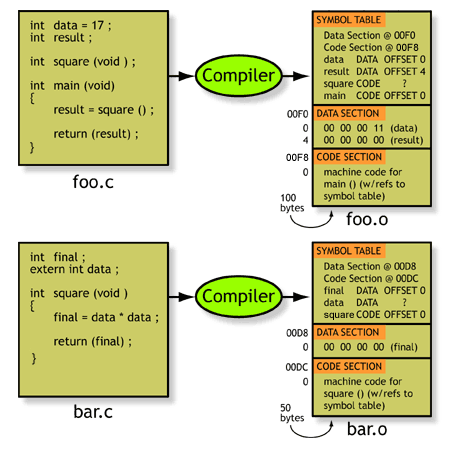
How Does A Compiler Work In A C++ Program?

A C++ compiler first checks all the syntaxes which are being used in a program. If the syntax is correct then compiler generates an assembly code for assembler. 
At the highest level, it takes c++ source code and converts it into code that the machine will understand. 
As we all know without compiler we are not able to make a program error free the compiler is resposible to check the syntax from right to left compilation.it tally code with the predefined files which are already defined with the compiler then our source file after the syntax checking is converted into object file ready to execute. When we compile file it send a message to operating system a message 0 or 1,if compiler found program error free then it send message and return o to operating system and for error return 1. 

Friday, 24 February 2012

14

20 February - 24 February 2012


Exploring on the C compiler. Never seen or use the C compiler. Feel a little bit shock and doing some research on Google. What is C compiler? How to use it? Will write about C compiler next week. Just collect data on C compiler.


taken from 

Friday, 17 February 2012

13

13 February - 17 February 2012

Busy doing proposal. Do some research on how to compile the coding into the integrated circuit.


Friday, 10 February 2012

12

See some seniors in college on how to develop the coding and related to the project. 

Thursday, 9 February 2012

11

Doing some research on C++. Find some interesting coding that can make reference. 

Wednesday, 8 February 2012

10

C language also have own syntax,keywords and arithmetic symbols that can be use. These characteristics might be apply into the software for this project.

Character set

The basic C source character set includes the following characters:
Newline indicates the end of a text line; it need not correspond to an actual single character, although for convenience C treats it as one.
Additional multibyte encoded characters may be used, but are not portable. The latest C standard (C11) allows multinational Unicode characters to be embedded portably within C source text by using a \uDDDD encoding (where DDDD denotes a Unicode character code), although this feature is not yet widely implemented.
The basic C execution character set contains the same characters, along with representations for alertbackspace, and carriage returnRun-time support for extended character sets has increased with each revision of the C standard. 

Keywords

C89 has 32 keywords (reserved words with special meaning):


break
case
char
const
continue
default
do


else
enum
extern
float
for
goto
if


long
register
return
short
signed
sizeof
static


switch
typedef
union
unsigned
void
volatile
while
C99 adds five more keywords:


_Bool
_Complex
_Imaginary


inline
restrict
C11 adds seven more keywords:


_Alignas
_Alignof
_Atomic
_Generic

_Noreturn
_Static_assert
_Thread_local

Operators

Main article: Operators in C and C++C supports a rich set of operators, which are symbols used within an expression to specify the manipulations to be performed while evaluating that expression. C has operators for:
  • equality testing: ==!=
  • sequencing: ,